
A Nation Assured: Canada's Coming of Age in the Second World War
- Timothy Knight

- Nov 25, 2025
- 4 min read
If the First World War was Canada's baptism by fire, the Second World War was its confirmation as a nation. The hard-won identity forged at Vimy Ridge was tested a generation later, not by an automatic obligation to Empire, but by a sovereign choice. When Great Britain declared war on Germany in September 1939, Canada, for one crucial week, remained at peace. It was a profound symbol of the autonomy won by the sacrifices of 1914-1918. Then, on September 10th, Canada's Parliament, in its own right and of its own free will, voted to declare war. The nation entered the abyss not as a colony, but as an equal partner, stepping onto the world stage to defend the very freedoms it had so recently secured.
This contribution would be total—industrial, civilian, and military—and would transform Canada from a dominion into a confident, capable, and indispensable middle power.

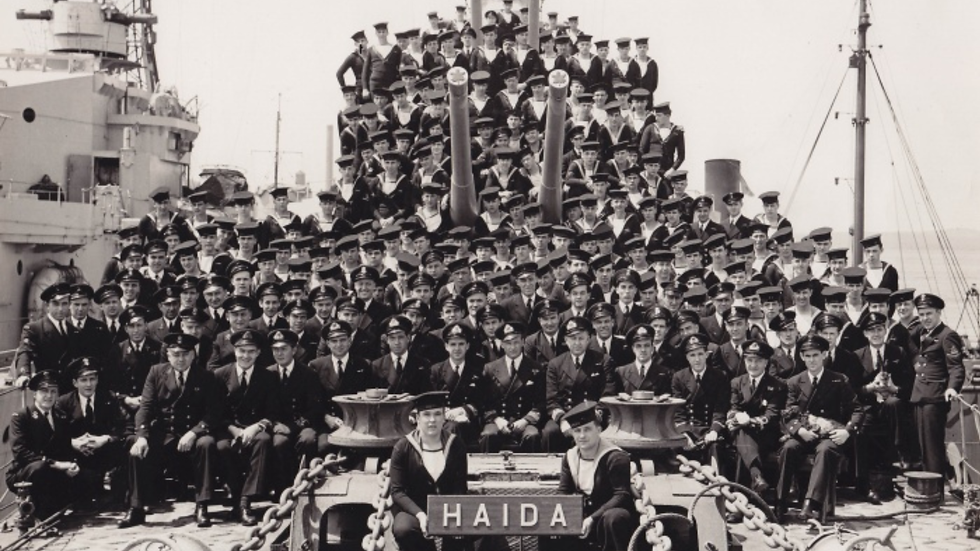
From a nation of just 11 million, over 1.1 million Canadians would serve in uniform. The country, still reeling from the Great Depression, was unprepared for war. Its permanent army was minuscule, its navy a handful of ships, its air force small. Yet, its potential was vast. That potential was first tested in the longest, most gruelling campaign of the war: the Battle of the Atlantic. The Royal Canadian Navy, which grew exponentially from 13 vessels to nearly 400, became the backbone of the convoy system. Manning frigates and corvettes—small, unglamorous ships for a cold, brutal duty—Canadian sailors hunted U-boats in the black expanse of the North Atlantic. It was a war of attrition, fought against torpedoes and relentless weather, but it was a war Canada had to win.
Without the "corvette navy" shepherding supplies and men to Britain, the war in Europe would have been lost.

Canada's commitment was global and, at times, tragic. In December 1941, two ill-equipped and undertrained Canadian battalions—the Winnipeg Grenadiers and the Royal Rifles of Canada—fought a hopeless, valiant battle against the Japanese invasion of Hong Kong. It was a doomed defence that ended in capture and years of brutal imprisonment. Then came Dieppe. In August 1942, the 2nd Canadian Infantry Division was tasked with the disastrous raid on the French port. It was a test of theories, a "reconnaissance in force" that turned into a massacre.
Of the nearly 5,000 Canadians who landed, over 3,300 were killed, wounded, or captured. It was a devastating failure.
Yet, even in that catastrophe, the character that defined the Canadian forces was evident. Honorary Captain John Weir Foote, a chaplain with the Royal Hamilton Light Infantry, embodied the bravery of compassion. For eight hours under relentless fire, Foote moved across the deadly beach, disregarding his own safety to tend to the wounded and dying, carrying men to the aid post. As the evacuation boats departed, he made a deliberate choice. Refusing rescue, he walked calmly into captivity, believing his duty was to remain with the men who needed him most in the prisoner-of-war camps. His Victoria Cross was not for taking life, but for affirming it in the face of hell.
The hard lessons of Dieppe, paid for in Canadian blood, directly informed the success of D-Day, but Canada's army would prove itself long before in the "soft underbelly" of Europe. In 1943, the 1st Canadian Division landed in Sicily and began the long, brutal slog up the Italian peninsula. This was a war of mountains, mud, and fortified German lines. The Canadians distinguished themselves in a vicious, house-to-house battle to capture the town of Ortona, a fight so intense it was dubbed "Little Stalingrad." As they pushed north, they faced the formidable Hitler Line. It was here, in May 1944, that Private Ernest "Smokey" Smith of the Seaforth Highlanders of Canada earned his Victoria Cross. With his company pinned down, Smith single-handedly stalked and destroyed a German Panther tank with an anti-tank projector.
He then used a submachine gun and his own ferocity to fight off waves of infantry, protecting a wounded comrade and securing the breach. His raw, tenacious courage exemplified the grit of the Canadian infantry.
The climax of Canada's war came on June 6th, 1944. On D-Day, Canada was not a supporting player; it was a principal. The 3rd Canadian Infantry Division was assigned its own beach: Juno. Facing heavy fortifications and rough seas, the Canadians stormed ashore and, in an incredible display of prowess, advanced further inland than any other Allied division that day. This was "Canada, the equal," in its most tangible form. The victory at Juno, however, opened the door to a bloody campaign in Normandy, fighting through the wheatfields of Caen and closing the Falaise Gap.

Perhaps Canada's most defining role came in the final months of the war. After the brutal, muddy battle to clear the Scheldt estuary and open the vital port of Antwerp, the First Canadian Army was given the task of liberating the Netherlands. They advanced into a country starved by the "Hunger Winter," where the civilian population was on the brink of annihilation. The Canadian soldiers were not just conquerors; they were liberators in the truest sense. They shared their rations, organised food drops, and were met with tears, flowers, and overwhelming joy.
To this day, the bond between Canada and the Netherlands is a sacred one, a living testament to the Canadian soldier's purpose.

At home, Canada had become the "aerodrome of democracy," training over 130,000 aircrew from across the Commonwealth. Its factories churned out planes, ships, and vehicles, becoming an arsenal for the Allied cause. When the guns fell silent in 1945, Canada had the fourth-largest air force and third-largest navy in the world. The cost was terrible: over 45,000 dead. But the nation that emerged was not the same one that had entered the war
It was a nation assured of its capabilities, its courage, and its place in the world. It had paid the price for its freedom, and in doing so, had secured that freedom for millions of others, proving itself, in every sense, the equal.

Comments