
The Unwavering Watch: Canada's Spirit of Service in the Age of Peacekeeping
- Timothy Knight

- Nov 11, 2025
- 4 min read

When the guns of the Second World War fell silent, Canada stood as a proven and formidable nation, its identity confirmed in the fires of the Atlantic, Italy, and Northwest Europe. The world that emerged from those ashes, however, was not one of lasting peace, but of fractured alliances, ideological divides, and a new, chilling "Cold War." The era of total war was over; the era of complex, ambiguous, and often thankless conflict had begun. In this new world, Canada would have to forge a new role. It chose not to be a conqueror, but a guardian. It translated the battlefield courage of its armed forces into a new kind of front-line duty: that of the peacekeeper.
This was not a passive choice, but an active, demanding, and dangerous one, defined by a profound esprit de corps—a collective spirit of service that would become a core part of the Canadian identity.

The genesis of this new role came in 1956, during the Suez Crisis. As the world’s superpowers postured on the brink of a wider conflict, Canada’s Secretary of State for External Affairs, Lester B. Pearson, proposed a radical idea: a neutral, armed United Nations force to stand between the combatants. It was a Canadian solution, and Canadians would form its backbone. The United Nations Emergency Force (UNEF) was born, and the "blue beret" became a symbol of a new kind of soldier. This was not the infantryman of Vimy or Ortona, tasked with taking an objective.
This was a soldier whose victory was defined by the absence of gunfire, whose weapon was restraint, and whose enemy was the very human impulse for violence.

This became the long, cold watch. For decades, the Canadian Armed Forces (CAF) became the world's go-to professionals for managing simmering conflicts. We remember Cyprus, where for nearly 30 years, Canadian soldiers patrolled the "Green Line" dividing a nation. They absorbed insults, de-escalated standoffs at checkpoints, and stood as a calm, professional buffer between two hostile populations. This was a test not of ferocity, but of patience and professionalism. It was a grind that required a deep, regimental discipline, an esprit de corps that held men together not in the heat of a single battle, but through the marathon of a tense, unending watch.
From the Sinai desert to the Golan Heights, Canadians took on this front-line duty, buying time for diplomacy that often never came.
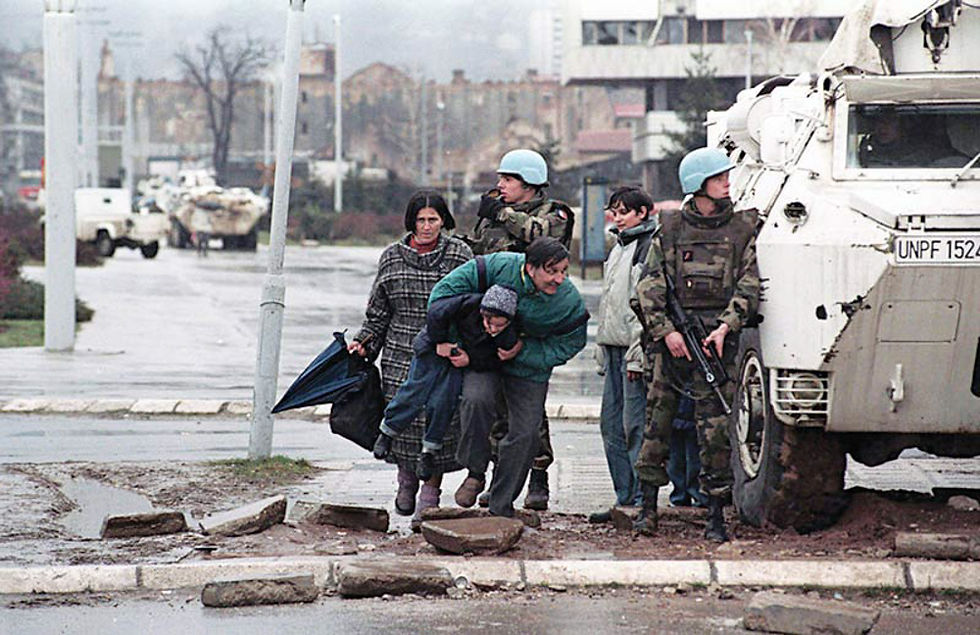
But the fall of the Berlin Wall shattered this stable, if tense, world. The new conflicts were not between nations, but within them. The line between peacekeeping and war blurred, and Canada’s spirit was tested as never before. In the fractured states of the former Yugoslavia, Canadian soldiers were sent to "keep a peace" that did not exist. In Bosnia and Croatia, they were no longer neutral observers but active protectors, often caught in the crossfire of brutal ethnic cleansing. At the "Medak Pocket" in 1993, Canadian troops engaged in a fierce, forgotten firefight—the most significant combat the nation had seen since Korea—to stop Croatian forces from slaughtering Serb civilians.
This was not peacekeeping; this was peace enforcement, and it demanded the courage of a combat soldier combined with the restraint of a diplomat.
This test of the soul found its darkest expression in 1994 in Rwanda. There, Canadian Major-General Roméo Dallaire commanded a small, under-equipped UN mission with an impossible mandate. When the genocide began, the world, in its shame, turned away. The UN ordered a withdrawal. General Dallaire, in an act of profound moral courage and ultimate duty, refused. He and his small contingent, including a core of Canadian soldiers, defied their orders to flee and stayed. They could not stop the slaughter, but they consolidated their positions, defended their posts, and actively saved tens of thousands of Tutsis who had sought refuge. Dallaire’s stand was a harrowing testament to the true meaning of service: a duty not just to a flag or a mission, but to humanity itself. It was the CAF’s esprit de corps laid bare—a spirit that would not break, even when abandoned in the face of unimaginable horror.
The 21st century blurred the lines completely. The mission in Afghanistan was not peacekeeping; it was a complex, 13-year war against a determined insurgency, fought alongside allies with the goal of building a stable nation. Here, a new generation of Canadian heroes upheld the same spirit of service. Captain Nichola Goddard, an artillery forward observation officer, embodied this modern force. She was a professional, a leader, and a dedicated soldier, serving on the front lines of a combat mission. In 2006, she was killed in a firefight, becoming the first Canadian female soldier to die in a combat role. Her sacrifice, and that of the 157 other Canadian soldiers who fell in Afghanistan, was a stark reminder that the duty to defend freedom—even the potential of freedom for others—remains a deadly and honourable calling.
This is the spirit of the modern Canadian Armed Forces. It is the legacy of Vimy, fused with the compassion of the Netherlands liberation, and tempered by the hard lessons of Cyprus, the Balkans, and Rwanda.

This esprit de corps is the unifying thread—a collective professionalism and profound sense of duty that allows a soldier to stand firm on a truce line, pull civilians from a warzone, or engage an enemy in combat, all in the service of a greater peace. It is the unwavering watch, kept by men and women who, in our name, continue to stand on the front lines of a complex world, guarding the fragile inheritance of freedom.

Comments